
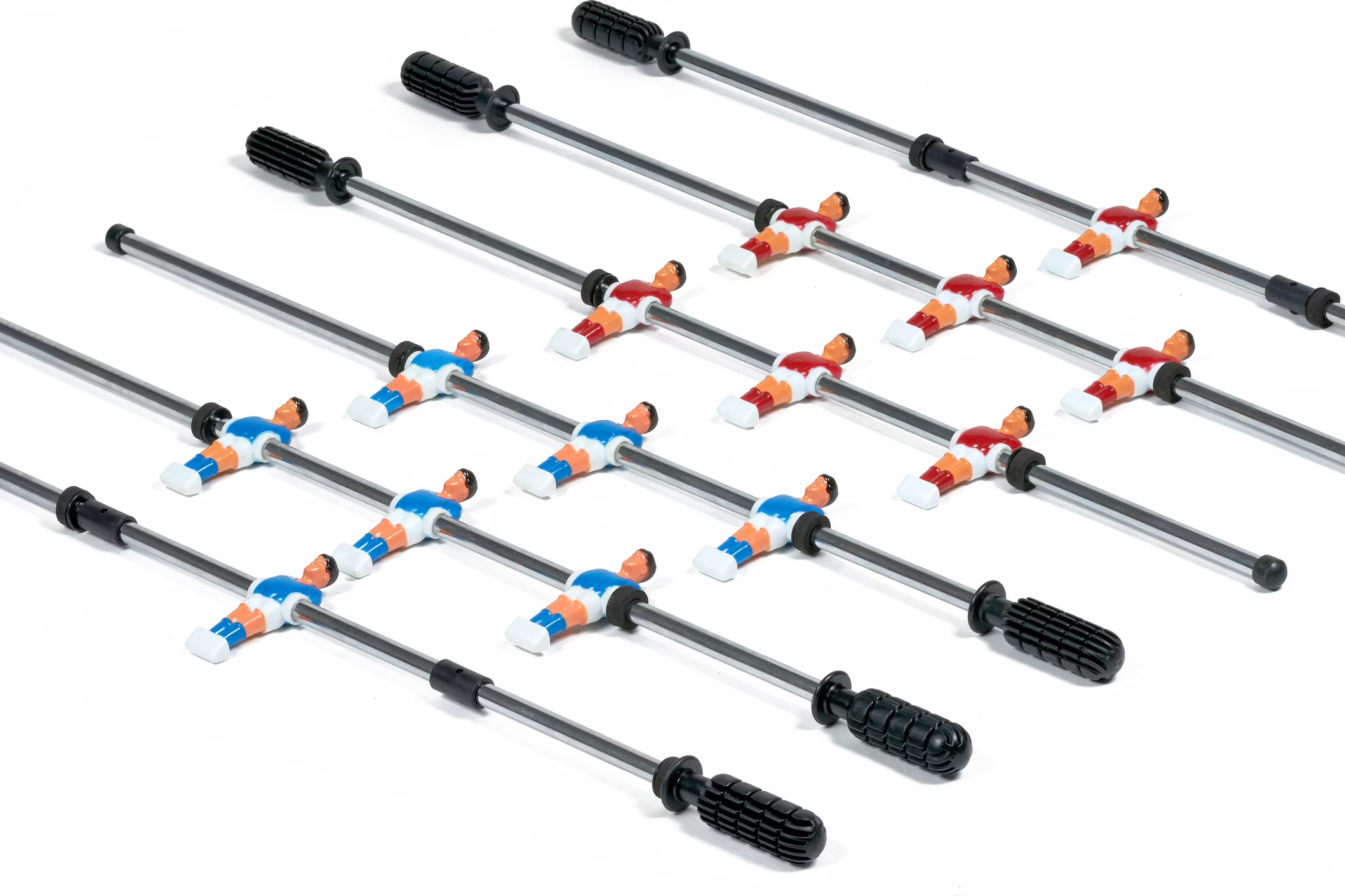
Selecting your foosball table rods is the most critical technical choice you will make. It is the primary interface between your hands and the match. At ocfoosball, we have been analyzing these mechanics since our domain was first registered in 2001. We have seen every design iteration over the last 25 years, and we know that the rod dictates the entire feel of the game.
The choice comes down to a fundamental difference in engineering:
- Telescopic Rods: These consist of two nested tubes that slide into each other. They never protrude through the opposite side of the cabinet, making them the gold standard for safety in family homes.
- Solid (Through) Rods: These extend fully across the playfield and poke out the other side when pushed. While they offer a more traditional, “connected” feel, they require more clearance space in your game room.
Expert Insight: In our two decades of tracking the industry, we have found that while pro-circuit players often prefer the raw feedback of through-rods, the modern home market has shifted toward telescopic designs for their space-saving and safety benefits.
Why the Engineering Matters
As we move through the 2026 season, the distinction between “furniture” and “professional instruments” has never been clearer. Whether you are looking for the explosive speed of hollow steel or the indestructible weight of solid steel, your foosball table rods are where the game is won or lost.
Comparison Table: Telescopic vs. Through-Rods (Solid/Hollow)
| Feature | Telescopic (Safety) Rods | Through-Rods (Solid/Hollow) |
| Price | Premium; higher manufacturing cost | Economy to Professional; varies by mass |
| Build Quality | Complex; involves inner and outer tubes | Simple; single-piece chrome or stainless steel |
| Weight | Variable; often feels “tip-heavy” | Hollow: Lightest; Solid: Heaviest |
| Gameplay Style | Finesse, “Pin Shots”, Safety-focused | Power, “Snake Shots”, Speed-focused |
| Warranty | Typically standard manufacturer terms | Varies; often high on premium solid/hollow |
Round 1: Design & Build (The Durability Duel)
The Winner: Through-Rods (Solid/Hollow)
When it comes to raw structural integrity, the simpler design of the through-rod wins every time. Professional through-rods, like the 16mm high-resistance steel used by Garlando, are cold-drawn and often chromium-plated for anti-rust protection. These rods are engineered to be up to 50% more torsion-resistant than standard models, ensuring they remain straight even under the downward pressure of an aggressive adult match.
Telescopic rods, while beautiful in their engineering, are inherently more complex. They utilize an outer tube and an inner “ground” rod that slides inside. Because they involve more moving parts and internal contact points, they require meticulous cleaning and are more susceptible to bending if a player leans on them while they are extended. If you are looking for a table that will survive decades in a high-traffic basement or commercial lounge, the solid or high-quality hollow through-rod is the benchmark for durability.
Round 2: Gameplay (The “Feel” Factor)
The Winner: Through-Rods (specifically Hollow Steel)
When it comes to the “snap” of the game, through-rods take the win. Specifically, hollow steel. It isn’t just a preference; it is physics. By stripping away rod mass, brands like Tornado and Leonhart give you higher acceleration. You get faster reaction times. This is the exact reason why the North American pro tour ignores everything else. These rods enable the 50-mph snake shots that define the modern competitive scene.
Telescopic rods play a different game. They offer a unique finesse feel, but they often feel tip-heavy. As the rod extends, the weight distribution shifts. This design is iconic for the French “Babyfoot” style seen on Bonzini tables. There, players use cork balls for high friction and precision pinning. It is a technical, deliberate way to play. However, it simply cannot match the explosive power of a professional through-rod. If you want lightning-fast rotation, you go hollow.
Round 3: Value (The Bang-for-Your-Buck)
The Winner: Telescopic Rods (For Household Safety)
While through-rods may win on performance, telescopic rods are the undisputed winners in terms of safety value. These are often called safety rods because they eliminate the risk of the rod protruding through the opposite side and accidentally hitting a spectator or a small child. In a family game room or a crowded public venue, the peace of mind provided by telescopic rods is worth the premium price.
Furthermore, brands like Warrior Table Soccer have successfully carved out a market niche by focusing on safety, utilizing rod guards on their sanctioned pro-spec tables to prevent injuries without the high cost of traditional telescopic systems. However, if your budget allows for an artisanal European build like a Bonzini or Roberto Sport, the telescopic rod provides a premium, safe, and sophisticated playing environment that through-rods simply cannot offer.
The Final Verdict: Which One Should You Buy?
- Buy Telescopic (Safety Rods) IF: You have small children running around the house, you are placing the table in a tight public space, or you prefer the traditional, finesse-heavy French or Italian style of play.
- Buy Hollow Through-Rods IF: You want to turn pro. Practicing on hollow rods on a table like the Tornado T-3000 is the only way to develop the muscle memory needed for the high-speed North American tournament circuit.
Foosball Tables by Rod Type
Tables with Telescopic (Safety) Rods
- Bonzini B90: The pinnacle of French artisanal design, featuring hand-painted aluminum men and telescopic rods for safe, high-finesse play.
- Roberto Sport Revolution: An ITSF-sanctioned table from Italy that uses telescopic rods and Teflon bushings for high-speed, technical performance.
- KICK Foosball Tables: Many home models from KICK offer telescopic upgrades to prioritize family safety in residential game rooms.
Tables with Through-Rods (Solid or Hollow)
- Tornado T-3000: The “Gold Standard” of the North American circuit, utilizing hollow steel rods for maximum acceleration and power.
- Leonhart Tournament: The German technical standard, known for its “New Tournament KL” players and precision hollow rods.
- Garlando World Champion: Features 16mm high-resistance through-rods with chromium plating for durability and rapid Italian-style “tic-tac” play.
How to Replace Your Foosball Table Rods: A Step-by-Step Guide
Maintaining “tournament ready” quality requires replacing rods as soon as they show signs of bending or chrome pitting.
1. Disassemble the Players and Handles
- For through-rods (Tornado/Warrior), use a pin punch to drive out the roll pins holding the men in place.
- For telescopic rods, refer to the manufacturer’s manual, as they often require removing the inner rod first to prevent damaging the internal sliding mechanism.
2. Slide the Rod Out of the Cabinet
- Remove the handle (some are screw-on, others are pressure-fit).
- Gently slide the rod through the bushings and out of the cabinet hole.
3. Inspect and Clean the Bushings
- Check the bushings for wear. Professional tables often use molded plastic or Teflon bushings to increase rod glide.
- If the bushings are worn, this is the ideal time to replace them for a “buttery” feel.
4. Install the New Rod
- Slide the new rod through the first bushing, reattach the players in the correct order/direction, and then slide it through the opposite bushing.
- Pro Tip: For through-rods, ensure you are using the correct rod for the specific row (e.g., 3-man vs. 5-man) as lengths and hole placements vary.
5. Lubricate for Professional Glide
- Once installed, apply 100% silicone-based lubricant to the rods.
- Move the rod back and forth several times to distribute the silicone evenly through the bearings.
- Common Mistake: Never use WD-40 or oil, as these attract dust and will eventually gum up the bearings.
- Check Our Ultimate Lubricants Guide
By understanding the physics and safety implications of your foosball table rods, you can ensure your equipment matches your playing goals—whether that is high-speed professional mastery or safe, all-weather family fun.