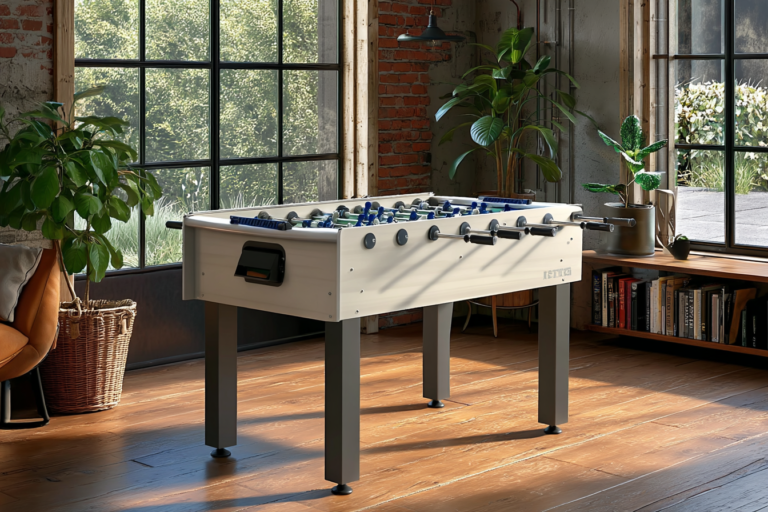
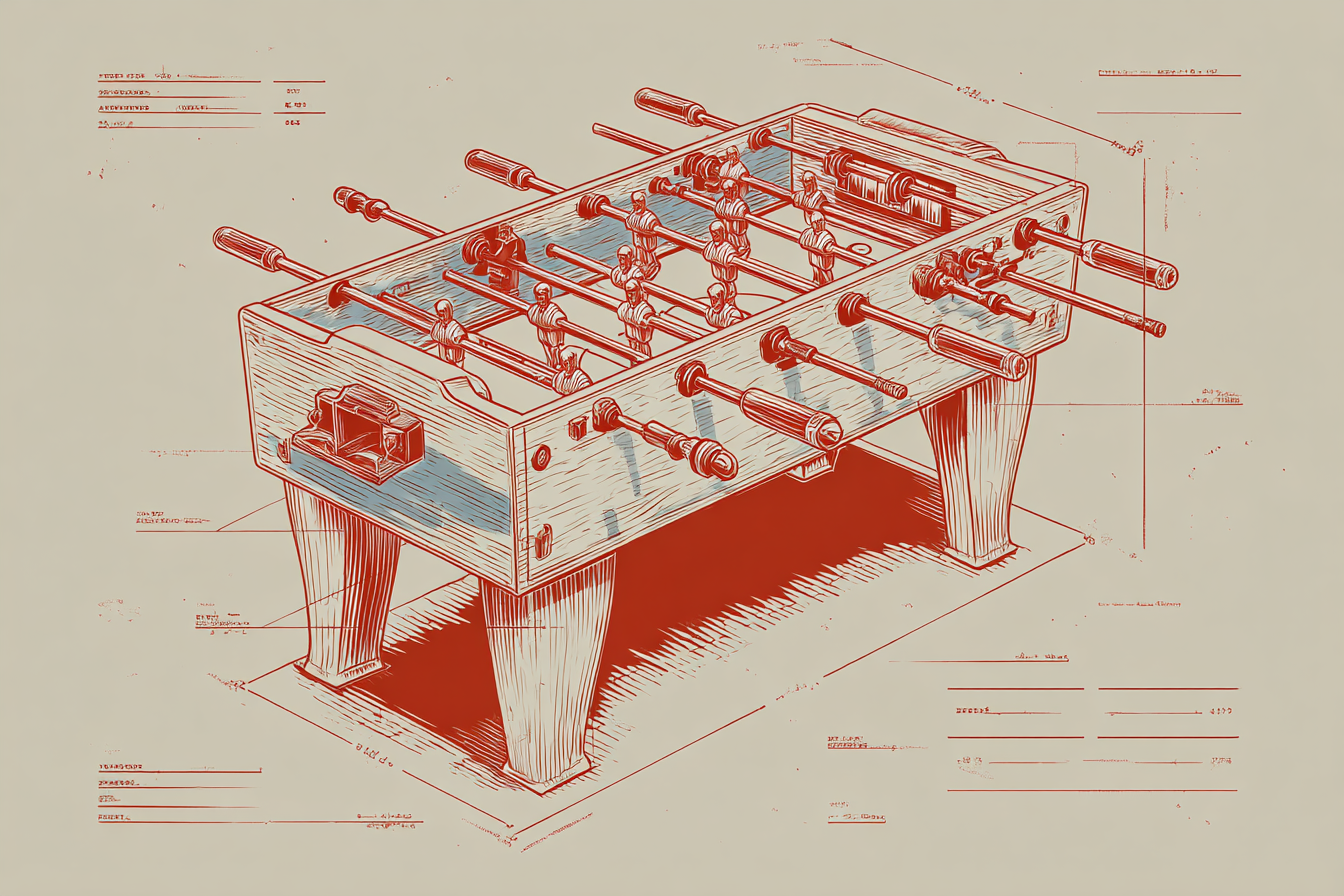
Size matters. If you get the measurements wrong, your practice becomes a waste of time. A professional table stands 36 inches high, 30 inches wide, and 56 inches long. The International Table Soccer Federation (ITSF) enforces these specific foosball table dimensions to keep the game fair. Consistency is everything. Whether you play in a local bar or a world championship, the field should feel identical.
Look at the Tornado T-3000. It uses a heavy-duty 56-inch frame that stays rock-solid. While external cabinet designs change, the internal playfield remains a sacred space. This standardization allows you to master technical maneuvers like the snake shot or the pull shot. But don’t just measure the wood. You need breathing room. Always leave an extra 12-18 inches of clearance on each side.
Another Options: Diverse Sizes in the 2026 Market
While the 56-inch tournament model is the “Gold Standard,” the current market has shifted toward “Quality Reset” and “spatial optimization,” leading to a wide variety of different sizes of foosball tables.
1. Professional Tournament Tables (The ITSF Standard)
These are the heavyweights of the industry. Brands like Tornado (USA), Bonzini (France), and Leonhart (Germany) define this category.
- Dimensions: Typically 56″ L x 30″ W x 36″ H.
- Weight: Often exceeds 200 lbs to ensure zero cabinet shift; the Tornado T-3000 tips the scales at 355 lbs.
- Best For: Competitive training, pro-circuit play, and corporate “brain sauna” wellness areas.
2. Residential Home Tables (The Mid-Sized Workhorse)
Home tables are designed to balance playability with household aesthetics.
- Dimensions: Often slightly shorter or narrower, ranging from 48 inches to 54 inches in length.
- Weight: Usually between 100 lbs and 150 lbs.
- Best For: Families, casual enthusiasts, and rooms where a full 56-inch pro table might be too imposing.
3. Tabletop and Mini-Foosball (Spatial Optimization)
As urban living spaces shrink, the demand for high-end “mini-pro” gear has surged by over 400% in recent years.
- Dimensions: Typically 32 to 40 inches in length and designed to sit on an existing desk or coffee table.
- Best For: Apartment dwellers, children, and portable “phygital” setups that sync with AI training apps.
4. Folding Foosball Tables
Designed for multi-purpose rooms where the table needs to be tucked away after use.
- Dimensions: Standard 54-56 inch length, but with legs that collapse to a depth of roughly 10-15 inches for vertical storage.
- Best For: School game rooms or shared community spaces.
5. 8-Player “XXL” Giant Tables
For large corporate events or social lounges, these extended tables allow for 4-on-4 play.
- Dimensions: Can exceed 8 to 10 feet in length.
- Best For: High-volume commercial settings, arcades, and team-building retreats.
Step-by-Step Instructions: How to Select Your Table Size
Selecting the right foosball table dimensions requires a methodical approach to ensure the equipment fits both your physical space and your playing ambitions.
- Measure Your Total “Foosball Footprint”:
Do not just measure the table. A 56-inch table actually requires a space roughly 10 feet by 8 feet. Measure the width with the rods fully extended on both sides to avoid hitting walls or furniture during intense defensive maneuvers. - Determine Your Goalie Configuration:
One goalie or three? You have to decide. American legends like the Tornado rely on a 3-man goalie system. This design kills the need for sloped corners because those outer men can easily snatch the ball from the backfield. It feels precise. European manufacturers take a different route by using a single goalie paired with ramped corners to keep the ball in constant motion. This choice dictates the actual tempo of your matches. It isn’t just a detail – it is the heart of your playstyle. - Evaluate Rod Clearance:
Select your rod type based on safety and speed. Telescopic rods (common in France/Italy) do not protrude through the opposite side of the cabinet, making them the ideal choice for small rooms or environments with children. Hollow steel rods are preferred for pro speed because their reduced mass allows for higher acceleration . - Verify Height for Ergonomics:
The standard foosball table size height is 36 inches, which is optimized for adult ergonomics to prevent back fatigue. If the table is primarily for younger children, look for adjustable leg levelers or junior-sized cabinets with a 30-32 inch height. - Calculate Weight vs. Floor Capacity:
If you are moving into a high-end pro table like the Tornado T-3000, ensure your flooring can handle 355 lbs concentrated on four small points. Always use the heavy-duty metal leg levelers to ensure a perfectly flat playfield, as even a minor tilt ruins the physics of the game.
Pro Tips: Insider Advice for Selection
The “Buttery” Rod Secret
Once you have selected your dimensions and assembled your table, never use WD-40. It eventually gums up the bearings. Only use 100% silicone-based lubricants to ensure the professional “glide” required for 50-mph shots.The Leveling Non-Negotiable
Even the most expensive standard foosball table size is useless if it is slanted. Use a carpenter’s level on the playfield (not the rails) and adjust the leg levelers until the ball remains perfectly stationary anywhere on the field.The Ball-Surface Connection
Match your ball to your table surface. For faster glass surfaces (Garlando), use a plastic or textured ball. For high-friction linoleum or wood (Bonzini), use a yellow cork ball for the best “pin shot” control.
What You Need: The Buyer’s Selection Checklist
Before you head to the market or click “Buy Now,” ensure you have the following tools and information ready:
- Measuring Tape: To verify the 10′ x 8′ room clearance.
- Carpenter’s Level: To verify the floor is ready for the leg levelers.
- Rod Type Preference: Have you chosen hollow (speed) or telescopic (safety)?.
- Goalie Style Preference: 1-man (European/finesse) or 3-man (American/power)?.
- Room Layout Plan: Ensure there is no direct sunlight on the playfield, as UV rays can warp laminates and fade the graphics over time.
Technical Synthesis: Brand-Specific Dimensions (2025-2026)
To reach the depth of a professional analysis, we must examine how the “Big Five” global brands utilize their cabinet footprints to encourage specific styles of play.
Tornado (USA): The Heavyweight Standard
The Tornado T-3000 is the anchor of the North American professional circuit.
- Length: 56 inches.
- Weight: 355 lbs (161 kg).
- Key Design: Uses a 1.5-inch thick MDF cabinet finished with stainless steel laminate for maximum rigidity. Its massive weight ensures zero movement during aggressive snake shots.
Bonzini (France): Artisanal Finesse
The B90 ITSF model represents the pinnacle of French “Babyfoot” control.
- Length: Roughly 59 inches (slightly longer due to the traditional headboards).
- Weight: 176 lbs (80 kg).
- Key Design: Hand-built from 22mm solid and laminated beechwood. It utilizes a linoleum playfield over a wood base, providing the highest friction in the sport when paired with cork balls.
Leonhart (Germany): Technical Versatility
The dominant force in Central Europe, Leonhart tables are known for their “nimble” but stable feel.
- Length: 56 inches.
- Weight: 242 lbs (110 kg).
- Key Design: Features ramped corners and sides for a “German” style that blends speed with technical control. Their “KL” players are specifically shaped to optimize ball control for technical passing.
Garlando (Italy): High-Speed Reflexes
Synonymous with rapid-fire play, Garlando tables utilize a sandblasted tempered glass surface.
- Length: ~56 inches.
- Weight: Often ranges around 165-175 lbs for home/pro models.
- Key Design: The glass surface reduces friction to almost zero, rewarding players with quick reflexes and the ability to execute “tic-tac” passing sequences at high speeds.
Final Strategic Summary
Selecting the correct foosball table dimensions is the foundation of your journey into the sport. In the 2025-2026 season, the industry is defined by a clear divide: the high-speed, power-oriented North American circuit (Tornado) versus the technical, high-friction European styles (Bonzini, Leonhart).
For the US market, the standard foosball table size 56-inch Tornado T-3000 remains the unmatched standard for those serious about professional competition. However, for schools, families, or urban dwellers with space constraints, the Warrior Professional or high-end mini-tables offer a compelling entry-point into the “brain sauna” of table soccer without sacrificing the technical integrity of the sport.
Whether you choose a 355-lb monster or a sleek 40-inch tabletop, ensuring you have the correct rod clearance and a perfectly level field is the only way to master the physics of the game.