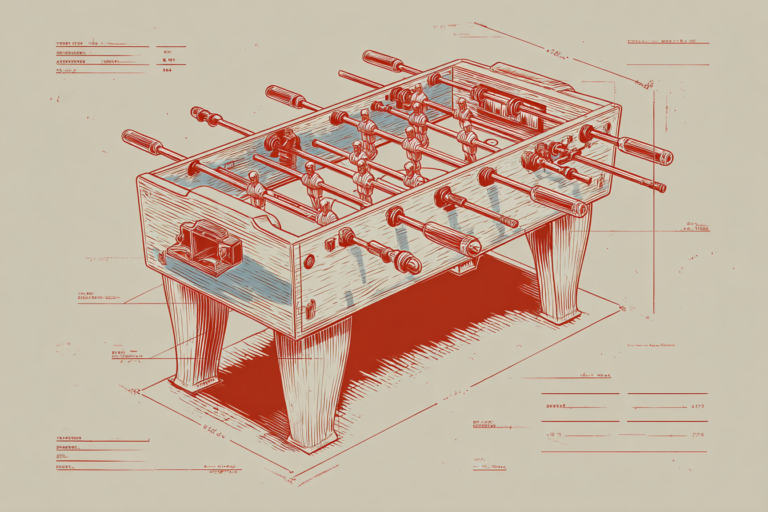
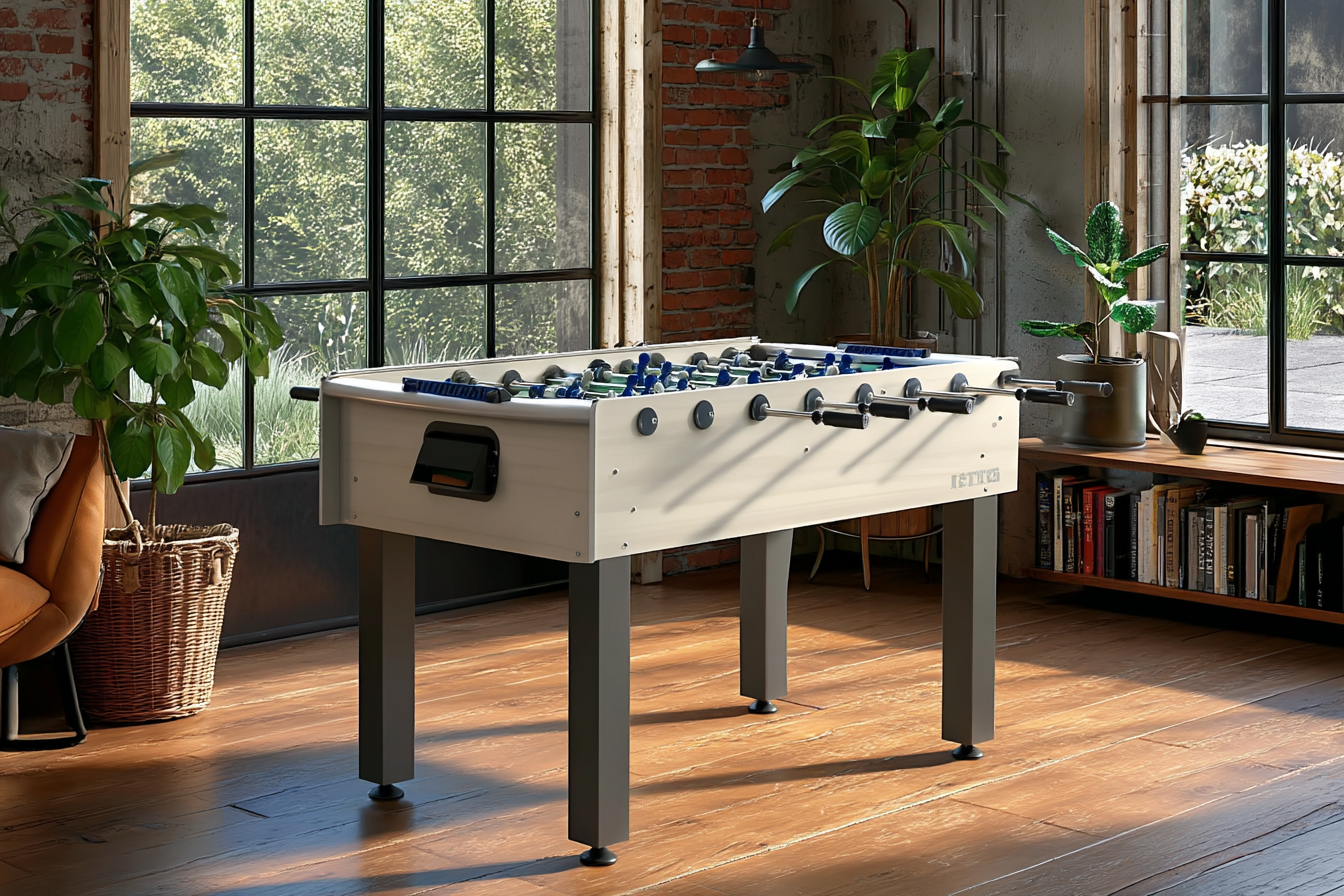
Imagine a soccer field – massive, green, and roaring with thousands of fans. Now, imagine a giant hand reaches down, plucks that entire stadium out of the ground, and shrinks it until it fits neatly inside a wooden box in your basement. The players are no longer superstars earning millions; they are tiny wooden soldiers skewered on metal sticks.
This is foosball. To some, it is a casual bar game; to others, it is the sport foosball, a high-speed battle of reflexes. but regardless of how you play, there is one question that almost always pops up mid-match: when was foosball invented?
The answer isn’t a single date on a calendar. Instead, it is a mystery story featuring matchboxes, hospital beds, and a linguistic “game of telephone” that traveled across the Atlantic.
The Spontaneous Birth (The Late 1800s)
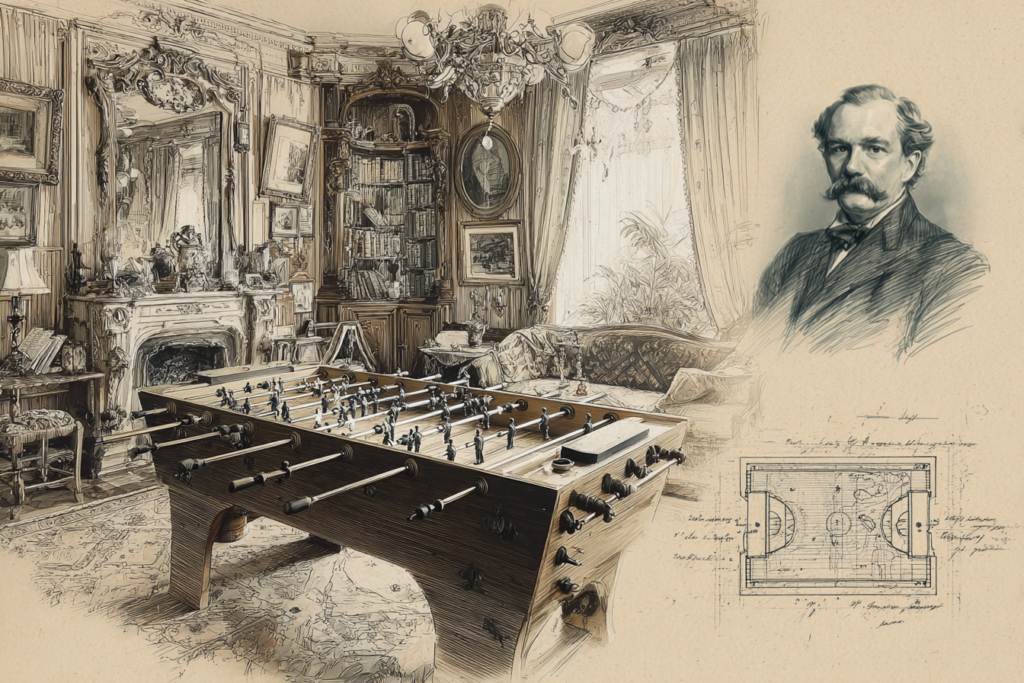
If we were to look for the very first “soccer-on-a-table” game, we would have to travel back to the late 19th century in Europe. Historians believe that foosball didn’t have one “Eureka!” moment. Instead, it was like popcorn popping in different pots at the same time.
In the 1880s and 1890s, the Industrial Revolution was in full swing. People were moving into cities, and space was becoming a luxury. You couldn’t exactly play a full game of soccer in a crowded London apartment or a Parisian café. Inventors began to experiment with “parlor games” – miniature versions of outdoor sports.
During this era, rudimentary versions of a foosball table appeared in Germany, France, and Spain. These early versions were basically wooden crates with holes at the ends and hand-carved players. They were the ancestors of the game, but they lacked the official “birth certificate” known as a patent.
The Matchbox Inspiration (Harold Thornton, 1923)
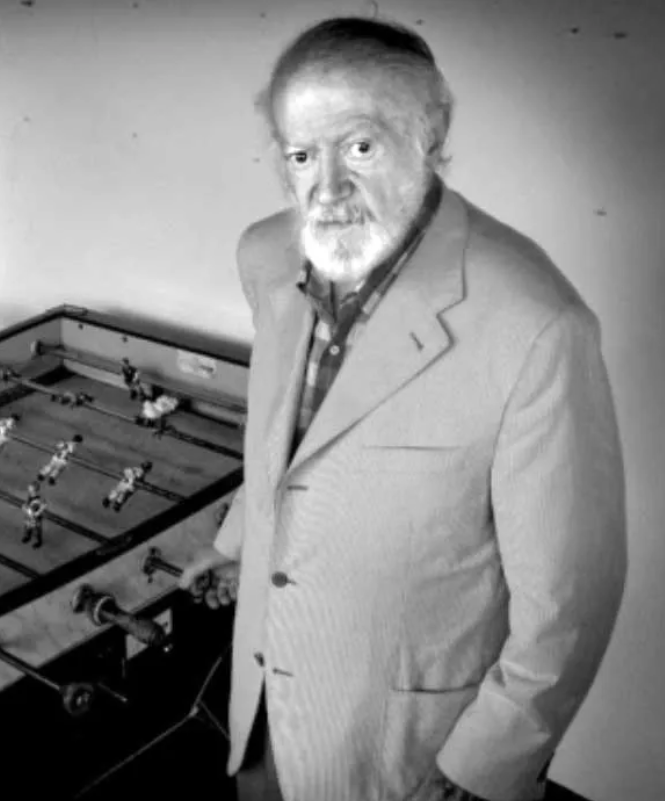
While many people played with the idea, an Englishman named Harold Searles Thornton was the one who made it “official.” Harold was a passionate fan of the Tottenham Hotspur soccer team. He wanted a way to bring the excitement of the pitch into his living room.
The story goes that inspiration struck while he was looking at a box of matches. If you lay a few matches across the top of a matchbox, parallel to each other, you have the basic blueprint of a foosball table. He imagined the matchsticks as rods and the box as the field.
On November 1, 1923, Harold was granted the first-ever patent for what he called “Apparatus for playing a game of table football.” This is generally considered the most solid answer to when was foosball invented.
Analogy Time: Think of Harold Thornton as the architect who finally wrote down the blueprints for a house that many people had been trying to build for years. He didn’t invent the concept of a house, but he gave it the shape we recognize today.
The Rival Claims: France and Spain
If you ask a Frenchman when the game was invented, they might give you a different name: Lucien Rosengart.
Rosengart was a brilliant engineer who helped invent things we use every day, like the seat belt and the front-wheel-drive engine. He claimed that he created the game in the 1930s to keep his grandchildren entertained during the brutal French winters. He called it “Babyfoot”—a name that is still used in France today.
Meanwhile, in Spain, Alexandre de Finesterre has his own legendary tale. During the Spanish Civil War in 1937, Alexandre was injured in a bombing raid. While lying in a hospital bed, surrounded by children who had also suffered leg injuries and could no longer play soccer, he felt a spark of inspiration. He worked with a local carpenter to build a table that allowed these kids to play their favorite sport using only their hands. He called it “Futbolín.”
Common Misconception: Many people believe there is only one inventor. In reality, foosball is more like a folk song—many different people added their own verses in different countries, and they all have a right to claim a piece of its history.
Why Do We Call It “Foosball”?
If the game was patented in England as “Table Football,” why do Americans call it “Foosball”? This is where the linguistic “game of telephone” comes in.
In Germany, soccer is called Fußball (pronounced “foos-ball”). When the game became popular in Germany after World War II, it was known as Tischfußball (Table Soccer). In the early 1960s, an American soldier named Lawrence Patterson was stationed in West Germany. He fell in love with the game and decided to bring it back to the United States.
Patterson trademarked the name “Foosball” in America and Canada. He essentially took the German word, “Anglicized” it (made it sound more English), and slapped it on his tables. So, every time you say “foosball,” you are actually using a slightly broken German word!
The American Boom and the “Coin-Op” Era
When foosball first arrived in the U.S. in 1962, it didn’t just walk into the room; it kicked the door down. Patterson was a smart businessman. He realized that if he put these tables in bars and arcades and made them “coin-operated” (meaning you had to drop a quarter in to release the balls), he could make a fortune.
By the 1970s, foosball was a national phenomenon. It was the “video game” before video games existed. People weren’t just playing for fun; they were playing for high stakes. This period saw the birth of sport foosball as a professional endeavor. There were regional tournaments with prize money that could rival a professional athlete’s salary.
However, foosball met its toughest opponent in the late 1970s: the silicon chip. When arcade games like Pac-Man and Space Invaders arrived, the tiny wooden men on sticks suddenly looked a bit “old school.” The popularity of the game dipped, but it never truly went away. It transitioned from a fad into a classic.
Scaling Up: Human Foosball
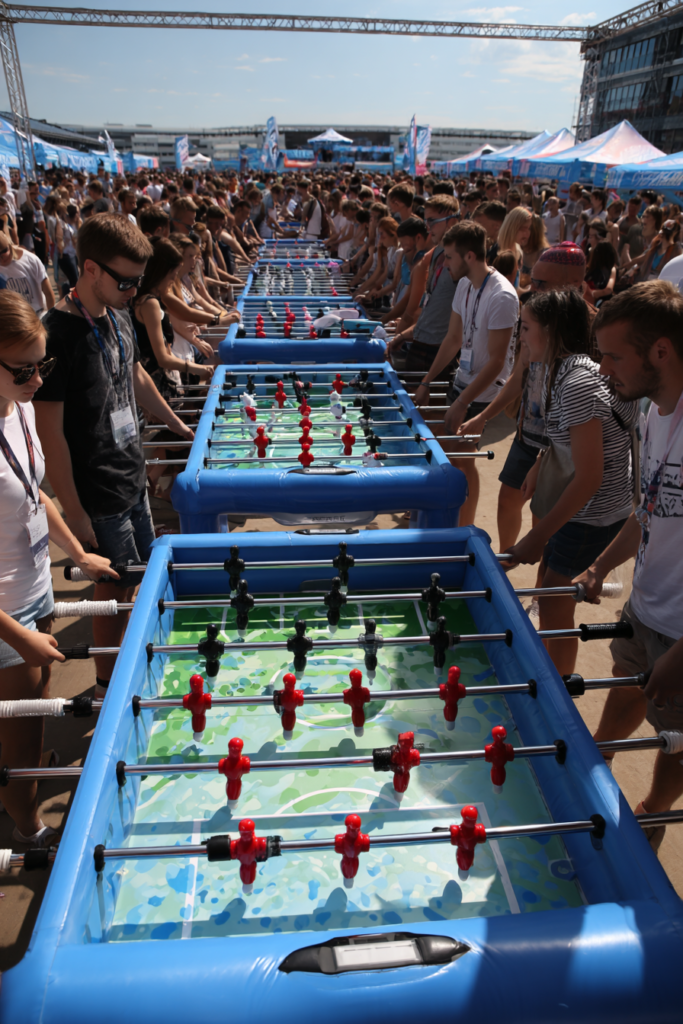
As the game evolved, people began to wonder: “What if we were the tiny men?” This led to the creation of human foosball.
In this version, a life-sized “table” (usually made of inflatable walls or wooden fences) is built. Players stand inside and hold onto horizontal bars. Just like the tiny figures on the table, they can only move side-to-side—no running up and down the field.
It is a hilarious, chaotic metaphor for the original game. It takes the “table” out of table soccer but keeps the restrictive, team-oriented mechanics that make the sport so unique. It’s like being a puppet where you and your teammates are all controlled by the same string.
Addressing Common Misconceptions
To truly understand when and how foosball was born, we have to clear away some of the “fog” that has settled over its history.
Misconception 1: It was invented for veteran rehabilitation.
You will often hear that foosball was created specifically to help soldiers recover hand-eye coordination after World War II. While it is true that foosball has been used very successfully in rehab centers and hospitals, that wasn’t why it was invented. It was a happy coincidence—a game created for fun turned out to be a great medicine for the mind and body.
Misconception 2: “Spinning” is a pro move.
If you walk up to a foosball table and spin the rods as fast as you can (the “helicopter” move), you might feel like a pro, but you are actually committing a “foul” in official rules. In sport foosball, spinning more than 360 degrees is illegal. Pro play is about “pinning” the ball and using a quick, controlled “flick” of the wrist.
Analogy: Spinning is like trying to play a piano by hitting all the keys at once. It’s loud and energetic, but it’s not music. Real foosball is about hitting the right note at the right time.
Misconception 3: It’s just a “bar game.”
While many people first encounter a foosball table in a dimly lit tavern, the game has a massive professional circuit. The International Table Soccer Federation (ITSF) regulates tournaments worldwide. There are official tables, specific ball types (some are “tacky” for grip, some are smooth for speed), and players who train for hours a day.
Technical Terms Defined (The “Zero Jargon” Zone)
To make sure we’re all on the same page, let’s define a few “pro” terms you might hear without using the confusing “insider” language:
- The Rods: These are the metal sticks that go through the table. Think of them as the “puppet strings” you use to control your players.
- The Men/Figures: The little plastic or wooden characters attached to the rods.
- The Playfield: The green surface the ball rolls on. It’s the “stage” where the drama happens.
- A “Dead Ball”: This is when the ball stops in a spot where none of the players can reach it. It’s the foosball equivalent of a “stalemate” in chess.
- Pinning: This is when you trap the ball between the player’s foot and the floor. It’s like a soccer player “trapping” the ball to get control before a shot.
Conclusion: A Century of “Table Soccer”
So, when was foosball invented? If you want the “legal” answer: 1923, thanks to Harold Thornton’s matchbox-inspired patent.
If you want the “cultural” answer: The 1890s, when it emerged as a mysterious parlor game across Europe.
If you want the “American” answer: 1962, when Lawrence Patterson gave the German word Fussball a new home.
Regardless of which date you choose, foosball remains a masterpiece of design. It is a game that takes one of the world’s most complex sports and distills it into its simplest form: you, a friend, some spinning sticks, and a tiny ball.
The next time you stand behind a foosball table, remember that you aren’t just playing a game—you are participating in a century-old tradition of bringing the “Beautiful Game” indoors, matchbox by matchbox. Whether you are playing the tabletop version or strapped into a game of human foosball, you are part of a history that is as fast, frantic, and fun as the game itself.