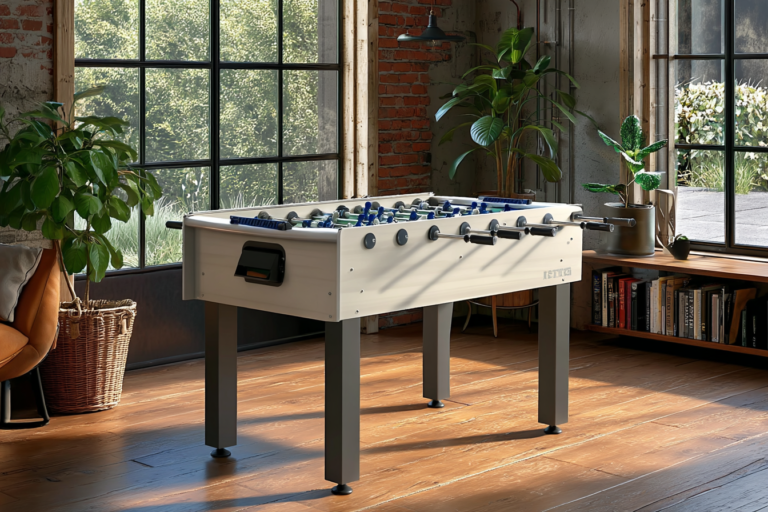
Is your foosball table a high-precision instrument or just a piece of basement furniture? In 2026, that distinction is no longer a matter of opinion—it’s a matter of certification. The International Table Soccer Federation (ITSF) has moved from being a niche governing body to the ultimate arbiter of quality in a global market now worth nearly $2 billion. As foosball sheds its “parlor game” reputation, the technical breakdown of what makes a table “tournament-legal” has become the hottest topic in the game room industry.
1. The Trend: A “Quality Reset” in Global Markets
We are currently witnessing a massive “Quality Reset” in the table soccer market. Interest in tournament-grade equipment is at an all-time high, with the commercial segment—bars, arcades, and gaming lounges—now accounting for 55-61% of total demand. This isn’t just a casual uptick; regional interest in North America and Europe has pushed annual global production to over 6.8 million units. Players are no longer satisfied with generic “big box” tables; they are searching for gear that matches the exact specifications used in the 100+ sanctioned ITSF events held annually4.
2. The “Why”: Three Drivers of Professionalization
The shift from recreational play to standardized competition is driven by three distinct forces:
I. The Physics of Performance
Professional play requires a table to act as a stable platform for physics-based maneuvers. Tournament-legal tables must have a cabinet weight exceeding 90 kg (200 lbs) to eliminate “cabinet shift” during aggressive power shots55. This structural integrity allows for the consistent execution of technical shots like the “snake” or “pull shot” that are impossible on lighter, flimsy models6.
II. Corporate Wellness and the “Brain Sauna”
High-end manufacturers are now marketing foosball as a tool for cognitive health. The “brain sauna” effect—the intense coordination between hands, eyes, and neural pathways—is being used to justify the installation of ITSF-sanctioned tables in corporate offices to combat employee screen fatigue and boost mental agility7.
III. The Rise of “Smart” Table Tech
Innovation is no longer just about wood and steel. In 2024 alone, over 3,000 smart tables equipped with motion sensors and digital scoreboards were installed in European sports bars8. These tables allow for real-time leaderboards and automated refereeing, bringing a “video game” level of data to the physical world9.
3. Data Breakdown: The Engineering of a “Pro” Table
To achieve ITSF certification, a manufacturer must adhere to strict component tolerances. Below is the technical breakdown of a tournament-legal 2025/2026 setup compared to recreational standards.
| Component | Tournament Standard (ITSF) | Recreational (Non-Pro) |
| Cabinet Weight | 90 kg to 161 kg | 30 kg to 60 kg |
| Rod Design | Hollow Steel (for high acceleration) | Solid Steel (heavy/fatiguing) |
| Goal Style | Corner-to-Corner (no ramps on Tornado) | Sloped plastic corners |
| Player Figure | Counterbalanced (stay horizontal) | Static (fall feet-down) |
| Surface Material | Sandblasted Glass or Pro-Laminate | Rough particle board or thin plastic |
4. Predictions: The Future of the Hobby
The next decade will likely see foosball move into the Olympic sphere. As the ITSF continues to standardize equipment, the hobby will bifurcate into two distinct markets:
- The “Eco-Pro” Class: A surge in tables made from FSC-certified wood and recycled marine plastics as Gen-Z consumers demand sustainability alongside performance.
- Skill Portability: As more schools (over 300 in China alone) adopt foosball as a sport, we will see a generation of players who can seamlessly transfer skills from a German Leonhart to an American Tornado.
5. Expert Opinion: Fad or Here to Stay?
“A professional table is no longer a luxury—it’s a requirement for the modern game. The move toward hollow rods and high-density MDF isn’t about ‘over-engineering’; it’s about ensuring that the force applied by the player translates perfectly into ball acceleration without losing energy to a shifting cabinet.”
At OC Foosball, our take is firm: the era of the “toy” table is ending. The $3 billion market projection by the mid-2030s isn’t based on casual sales, but on a global commitment to table soccer as a legitimate, technologically advanced competitive discipline.